
Madu Ganga is a working estuary, not a reserve with a gate. The 248 vertebrate species recorded here are spread across open water, mudflats, mangrove, island scrub and the paddy and coconut land at the margins — and most of them are not waiting where the boats go.
That said, an early two-hour circuit reliably produces a decent list, and it does so with almost no effort. The variable is the hour you leave.
Birds you can expect
On the water and at the edges
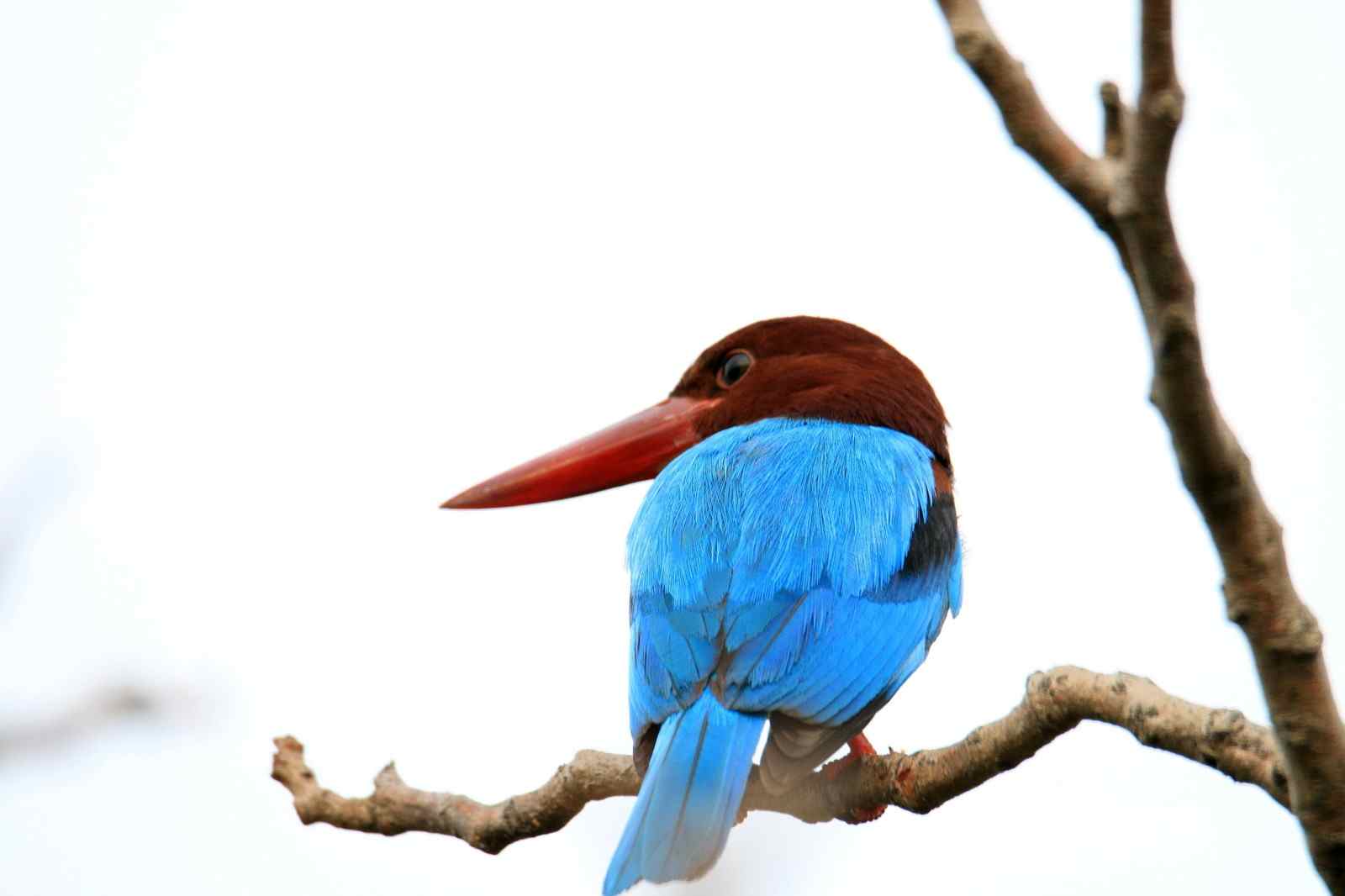
- White-throated kingfisher — the default kingfisher here. Chestnut body, brilliant blue back and wings, white bib, red bill. Perches on stakes and fence posts and calls loudly. You will see several.
- Common kingfisher — smaller, electric blue, low and fast down the channels. Easy to miss.
- Stork-billed kingfisher — big, heavy red bill, much scarcer. A genuinely good sighting.
- Little and Indian cormorants — perched with wings spread on the prawn-trap stakes, drying out.
- Little egret, intermediate egret, grey heron, purple heron — standing in the shallows, mostly at dawn.
- Indian pond heron — dull and invisible until it flies, then startlingly white.
Overhead
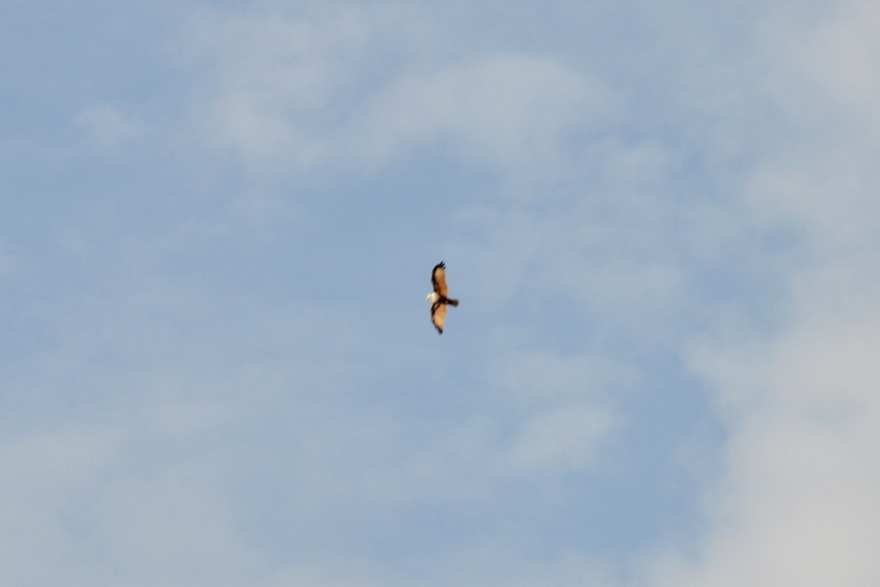
- Brahminy kite — chestnut body, white head, the commonest raptor on the coast. Constantly in view.
- White-bellied sea eagle — much larger, black and white, often over the wider water. A highlight when it appears.
In the vegetation
- Green bee-eaters, Asian koels, red-vented bulbuls, Sri Lanka’s ubiquitous common mynas, and — if you are lucky and quiet — a black-hooded oriole.
Reptiles
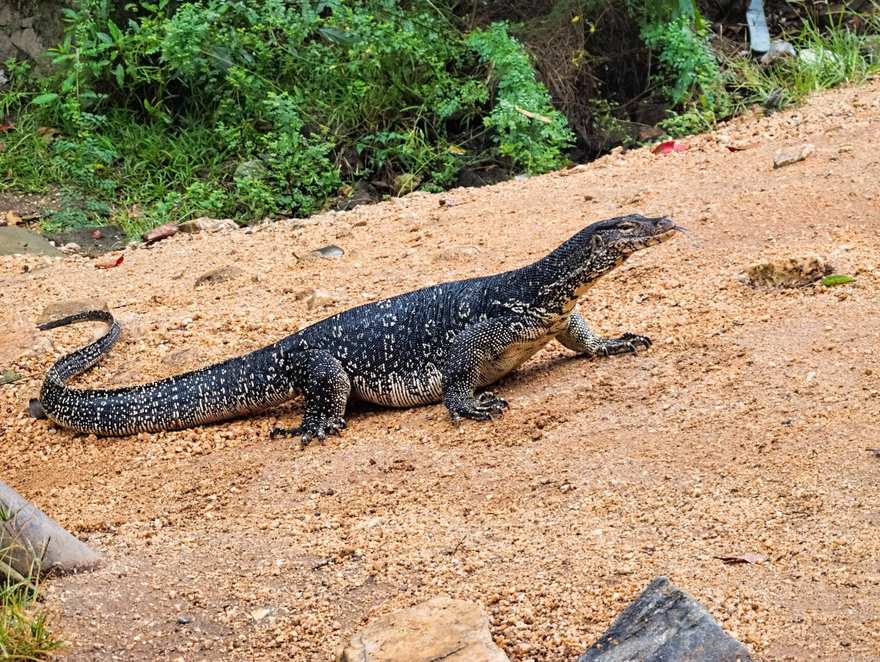
Water monitor (Varanus salvator) — the animal you will definitely see. Sri Lanka’s largest lizard, routinely a metre and a half or more, entirely at home in brackish water and perfectly capable of climbing. They swim with the body low and the tail sculling, and they bask on horizontal branches over the channel.
Crews will sometimes call them crocodiles. They are not, and telling the difference is easy: monitors climb, crocodiles do not.
Mugger crocodile (Crocodylus palustris) — genuinely present, and named in the Ramsar site documentation as a vulnerable species the wetland supports. Sightings on the tourist circuit are uncommon, partly because the animals avoid engine noise and partly because the busy channels are not where they sit. Treat any sighting as a bonus, not an expectation.
Snakes — several species including water snakes and, in the vegetation, the occasional green vine snake. Rarely seen from a boat.
Mammals
- Toque macaque — endemic to Sri Lanka, the small brown monkey with the swirl of hair on its head. Common on the islands and around Kothduwa temple.
- Grey langur — larger, longer-tailed, more dignified, less interested in your bag.
- Flying foxes — Indian flying foxes roost in tall trees near the water and are visible hanging in the canopy during the day. Impressive at dusk.
- Otters — smooth-coated otters are present in this system and are seen occasionally at dawn. A rare and excellent sighting.
- Wild boar — mentioned in tour descriptions, genuinely present in the surrounding scrub, almost never seen from a boat.
Fish and the things that eat them
The estuary’s productivity is the reason for everything else. Juvenile fish shelter in the mangrove roots, prawns move with the tide into the traps, and the entire bird list is downstream of that. The wooden fences you pass are part of a fishery that has been worked continuously for generations — the traps are the ecosystem’s clearest visible sign that it still functions.
How to actually see more
-
Leave at 06:30
Not 09:00. This one decision changes the species list more than everything else combined. Birds feed at first light and retreat to shade by mid-morning.
-
Ask for a slow boat
Tell the crew you want to look for birds. Most will happily idle along the shallow margins rather than run the middle of the lagoon, and it costs nothing.
-
Take binoculars
Any pair. The difference between a distant white bird and an identified intermediate egret is one piece of equipment nobody provides.
-
Sit at the bow and stay quiet
Engine noise is unavoidable; conversation is not. Herons hold their position for a quiet boat and flush from a loud one.
-
Watch the margins, not the middle
Everything happens in the first three metres from the bank. The open water in the centre of the lagoon is empty.
What this is not
Madu Ganga is not a big-game destination. There are no elephants, no leopards, no herds of anything. If your expectation is set by Yala or Udawalawe you will be underwhelmed, and the honest recommendation is to do both — a morning on the estuary and a separate day in a national park. They are different experiences that happen to share the word “safari”.
What Madu Ganga offers instead is density and access: a functioning wetland ecosystem you can be inside, at eye level, twenty minutes after breakfast.
Sources
- Ramsar Sites Information Service — Maduganga (site 1372) Species of conservation concern including Crocodylus palustris and Shorea affinis
- Department of Wildlife Conservation, Sri Lanka Protected species and wildlife regulations
- IUCN Red List Conservation status of mugger crocodile and smooth-coated otter
Frequently asked questions
What animals will I see on Madu River?
On an early boat, expect kingfishers, egrets, herons, cormorants and at least one water monitor. Brahminy kites and sea eagles are common overhead. Monkeys are reliable on the wooded islands. Anything beyond that is luck.
Are there crocodiles in Madu Ganga?
Yes. The mugger crocodile, Crocodylus palustris, is listed among the wetland's notable species in the Ramsar documentation. Encounters on a standard tourist circuit are uncommon. Most of what crews call a crocodile is a water monitor.
What is the difference between a water monitor and a crocodile?
Water monitors are lizards with long forked tongues, a tapering snout and a habit of climbing trees and swimming with the body high in the water. Crocodiles are broader, blunter and lie low with only eyes and nostrils showing. If it is in a tree, it is a monitor.
Is Madu River good for birdwatching?
For a two-hour trip in an accessible location, yes. It is not a specialist birding destination like Bundala or Kumana, but the mix of open water, mudflat, mangrove and adjacent paddy delivers a solid list before breakfast.
Will I see monkeys?
Almost certainly, on the wooded islands and at Kothduwa temple. Toque macaques and grey langurs are both present. Do not feed them, and do not let the crew feed them for a photograph.
Do I need binoculars?
They transform the trip and nobody hands them out. Anything from 8x32 upwards is enough. Without them you will see birds; with them you will identify them.
Keep reading
- The Madu Ganga Mangrove Safari, ExplainedThe mangrove tunnel is the photograph everyone comes for, and it lasts about ten minutes. The other hundred are what separate a good boat trip from a bad one.
- Best Time to Visit Madu River — Hours, Season and DurationBoats run all day and the trip works all year. But the gap between a 06:45 departure and a 13:00 one is the difference between a wildlife trip and a hot boat ride.
- The Ethics of a Madu River Boat TripA protected wetland with no gate, forty boats and no enforcement on the water. Most of the damage is casual rather than malicious, and most of it stops if a passenger asks.
- What to Bring on a Madu River Boat TripTwo hours in an open boat on the equator, with a temple stop and no shops. The list is short, but three items on it are the difference between a good morning and a miserable one.