
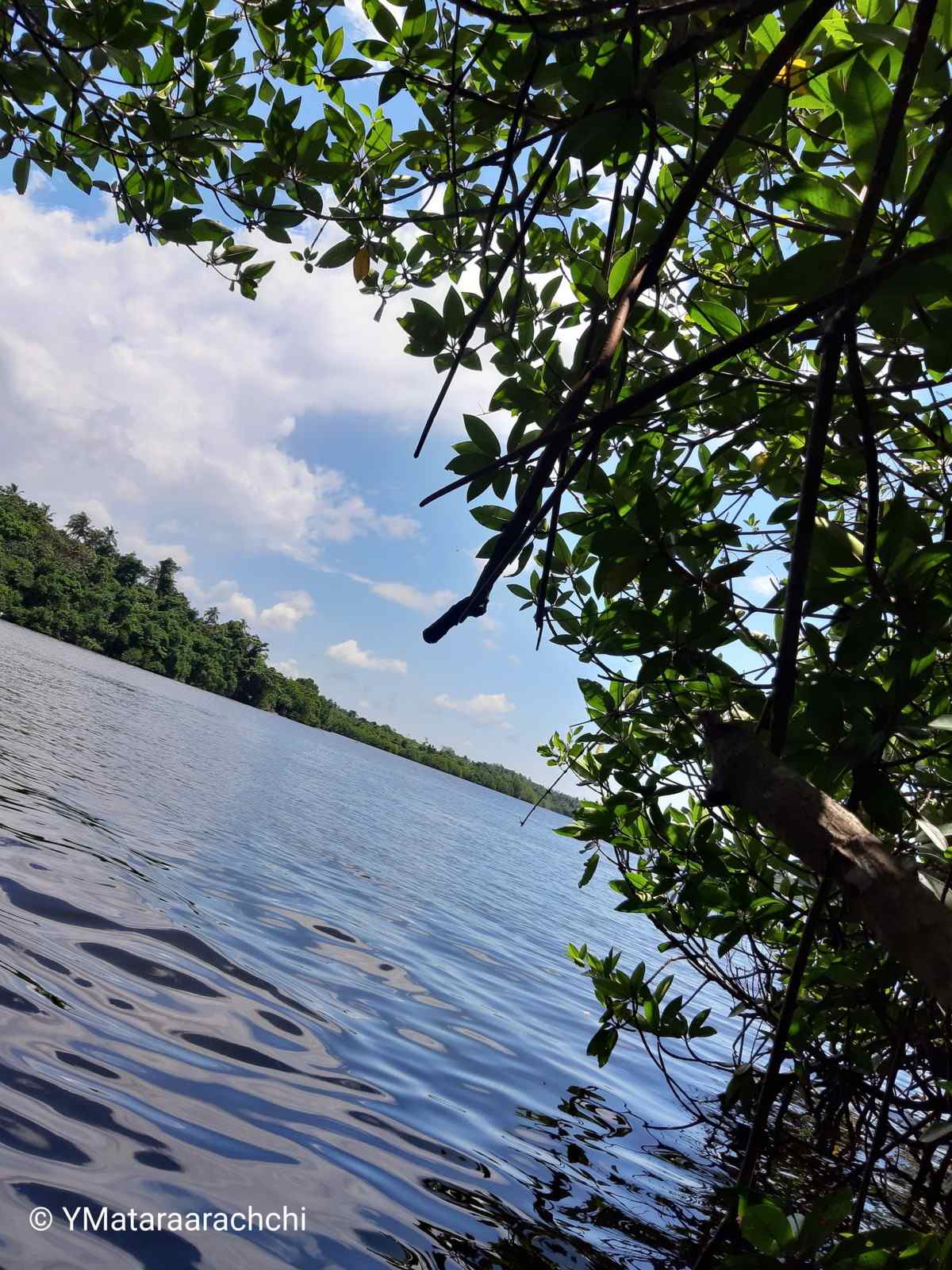
Maduganga was added to the Ramsar list of Wetlands of International Importance on 11 December 2003. The listing describes relatively undisturbed mangrove vegetation supporting rich biodiversity, including nationally and globally threatened species — the endemic, endangered tree Shorea affinis and the vulnerable mugger crocodile among them.
Designation is a legal status, not a fence. There is no ranger station on the water and no boat inspection. What actually happens on the estuary is decided by about forty crews and the people paying them.
The real problems, in order of size
1. Engine wake in the narrow channels
This is the one you can see. Along the busiest routes the banks are undercut, the mud is exposed and young mangrove seedlings have been washed out at the waterline. Wake energy in a two-metre channel has nowhere to go except sideways into the roots.
The fix is trivial and free: crews idle through the channels instead of running them. Most will, if asked. Some do it as a matter of course — those tend to be the same crews that give a full two hours.
2. Feeding animals for photographs
Monkeys at the temple, monitor lizards at the island jetties, sometimes fish over the side. It is done to produce a five-second photo opportunity and it has a long tail of consequences: habituated macaques raid boats and bags, become aggressive, and are eventually removed by people who live on the islands. Monitors that associate boats with food lose their wariness entirely.
If a crew offers, say no. It is not confrontational and it works.
3. Staged “cinnamon farms”
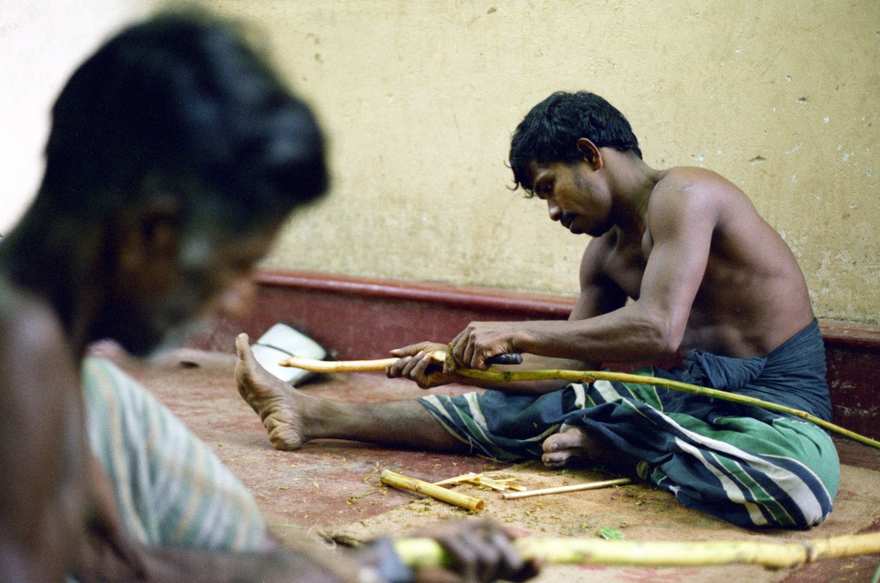
Not an environmental problem, a transparency one. Some island stops are genuine smallholdings where a family peels bark for a living. Others are retail outlets that run a demonstration to sell product at tourist prices.
The distinction matters because visitors are told they are seeing a farm. You can tell in about fifteen seconds: real operations have drying racks stacked with quills, brass rods worn smooth, and offcuts underfoot. Shops have a display table.
4. Waste on the islands
There is no municipal collection out there. Whatever comes off a boat stays. Take your bottles back with you — including the ones the floating shop sold you.
What the boat trip does well
It would be dishonest to leave it at the criticism. Mangrove estuaries across South Asia have been cleared for shrimp ponds, housing and rice. Madu Ganga has not, and one substantial reason is that the standing forest earns money for the households around it, every morning, in cash.
- The islands are inhabited and the residents have a direct stake in the trees staying up.
- Traditional prawn and fish traps still operate alongside the tourist boats, and both depend on the same water quality.
- The 2004 tsunami made the coastal-protection argument locally in a way no campaign could — vegetated shoreline behaved measurably differently from cleared shoreline.
Boat tourism here is not the threat to the mangroves. Careless boat tourism is a manageable, visible cost of the thing that keeps them standing.
Three questions that fix most of it
-
How long is the trip, and which stops?
Sets the expectation in front of witnesses and removes the incentive to make time up by driving fast through the channels.
-
Will you idle through the tunnel?
A crew that says yes without hesitating has thought about it before. A crew that looks puzzled is telling you they have not.
-
Are we stopping anywhere that feeds animals?
Signals clearly that the monkey-feeding photo is not what you are paying for. In practice this ends the conversation before it starts.
On the fish spa
Worth stating plainly rather than moralising. Garra rufa pedicures are banned or restricted in a number of jurisdictions on hygiene grounds, and the fish here live in a pen on the estuary rather than a filtered tank. Some visitors are comfortable with that; others are not.
Two positions are both reasonable: skip it, or do it and do not pretend it is anything other than a novelty. What is not reasonable is doing it with an open wound.
Choosing well without being difficult
You are not going to reform the river from a boat. What you can do is spend your money in the direction of the crews that behave better, and make that visible.
- Book with an operator that publishes a duration and is accountable for it.
- Pay for the full circuit rather than the short loop, if you can afford to — it is what keeps the longer route commercially viable.
- Tip the crew that idled and explained things, not the crew that got you back in forty minutes.
- Say why. A sentence at the jetty travels further than a review nobody reads.
Sources
- Ramsar Sites Information Service — Maduganga (site 1372) Designation, area, vegetation and threatened species
- The Convention on Wetlands — Sri Lanka names mangrove lagoon for the Ramsar List
- Central Environmental Authority, Sri Lanka Wetland management and coastal environmental regulation
- Department of Wildlife Conservation, Sri Lanka Rules on feeding and disturbing protected species
Frequently asked questions
Is the Madu River boat safari bad for the environment?
Not inherently. Boat tourism gives local families a reason to keep the mangroves standing rather than clear them. The damage comes from how boats are driven — wake in narrow channels erodes banks and tears out seedlings — and that is a behaviour problem, not a structural one.
Are the cinnamon islands real farms?
Some are. Others are retail stops with a peeling demonstration attached. Look for drying racks, worn peeling tools and offcuts on the ground. A display table and a shelf of packets is a shop, which is fine as long as you know what you are buying.
Should I do the fish spa?
It is a personal call. The fish are kept in a pen on the estuary and the practice is banned in some countries on hygiene grounds. If you have broken skin, skip it. If you are uneasy about the enclosure, skip it — the tour is not diminished.
Is it wrong to feed the monkeys?
Yes, and it is the single most damaging thing that happens on this trip. Fed macaques lose their fear, raid boats and bags, and are eventually dealt with by people who live there. Decline it if a crew offers.
Who protects Madu Ganga?
The wetland was designated under the Ramsar Convention in 2003 and falls under Sri Lankan environmental and wildlife legislation. Day-to-day conduct on the water, however, is largely down to individual boat crews and the passengers paying them.
How do I choose a responsible operator?
Ask three questions before you pay — how long is the trip, does the boat idle through the tunnel, and are we stopping anywhere that feeds animals. The answers, and the way they are given, tell you most of what you need to know.
Keep reading
- The Madu Ganga Mangrove Safari, ExplainedThe mangrove tunnel is the photograph everyone comes for, and it lasts about ten minutes. The other hundred are what separate a good boat trip from a bad one.
- Kosgoda Turtle Hatcheries — The Honest VersionTen minutes south of the Madu Ganga jetties, a row of turtle hatcheries takes almost every boat passenger who asks for a combo. Some do real conservation work. Some are aquariums with a donation box.
- Madu River Boat Operators — Who Runs WhatThere is no association, no register and no grading. What exists is a row of jetties, about eleven business names that keep appearing in map searches, and a great deal of overlap between them.
- Madu River Wildlife — Birds, Monitors and What You Will Really SeeThe wetland supports 248 vertebrate species. A midday boat shows you four of them. What you see depends almost entirely on when you leave and how quietly your crew drives.