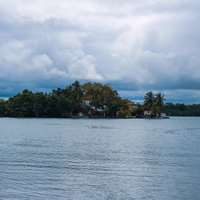
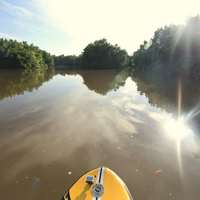
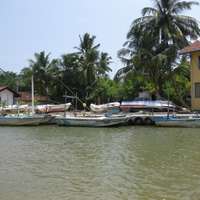
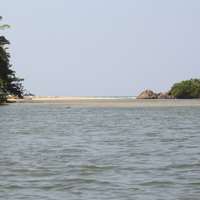
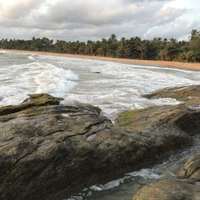
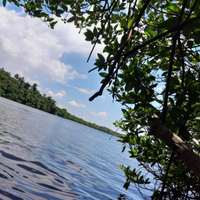
Madu Ganga is not a river in the way the name suggests. It is a shallow brackish lagoon fed by fresh water from inland and flushed twice a day by the Indian Ocean through a channel barely four kilometres long. That mix is the whole point: it is why mangroves grow here in dense stands, why the fish are worth catching, and why the birdlife is heavier than anywhere else on this stretch of coast.
For visitors, all of that arrives in the form of a small outboard boat leaving from a jetty near the Galle Road bridge in Balapitiya. What you get for your money varies more than almost any other paid experience in southern Sri Lanka — from a genuinely good two and a half hours to a rushed forty-five minutes with a hard sell at the end.
What the boat trip actually covers
A full Madu Ganga safari is a loop, not a straight run. Boats leave the jetty, cross the open lagoon, thread the mangrove channels, stop at two or three islands, and come back the way they came. The standard stops, in the order most crews take them:
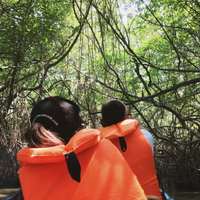
- The mangrove tunnel — a low channel where the canopy closes overhead. It is the single image everyone comes for, and it takes about ten minutes to pass through.
- Kothduwa Temple island — a small forested island with a Buddhist temple. Local tradition connects it to the first higher-ordination ceremony of the Amarapura Nikaya, held on boats moored in this lagoon in 1803.
- A cinnamon island — a smallholding where someone peels Cinnamomum verum bark and demonstrates the process. Some are working farms. Some are shops with a demonstration attached.
- The fish spa — a floating pen of Garra rufa. Optional, usually a small extra charge, entirely skippable.
- A floating shop — cold drinks, king coconut, souvenirs. Cash only.
How many islands are there, really
Operators advertise 64 islands. The Ramsar Sites Information Service, which is the legal basis of the wetland’s protection, describes 15 islands of varying size, some of them inhabited. Both numbers are defensible: the higher count includes every scrap of vegetated mud that stays above water at low tide, and the lower one counts land that behaves like an island year-round.
It matters only because it tells you something about the marketing. When a listing leads with “64 islands” and “Ramsar” in the same sentence, the two facts come from different places, and only one of them is documented.
What it costs
There is no fixed price on Madu Ganga, and any site that publishes one is guessing. Two things are true at the same time:
- At the jetty you rent the boat, not a seat. The quoted figure covers the whole vessel, which is why a couple pays a punishing per-head rate and six people pay very little. Negotiation is expected and the opening ask is not the price.
- Online you buy a seat. A per-person two-hour Madu River safari starts at about US$20–30, and combined day trips from Colombo or Galle run US$45–130 depending on what is bundled.
The comparison people want — jetty cash versus online booking — is not really about money. It is about who is accountable if the boat is late, the engine floods, or the “two-hour tour” ends after fifty minutes. Our prices page sets out the whole structure, including the extras that are never in the first quote.
Madu River Boat Tour and Cinnamon Garden Visit
Ceylon Nature Tours
The best-reviewed dedicated Madu River trip on the coast: boat, mangrove channels and a cinnamon island, without a full-day commitment.
- 1–2 hours
- ★ 4.6 · 26
from $29
AvailabilityMadu River Boat Safari — Eco Cinnamon Islands
Madu River Boat Safari
Two hours, private boat, the island circuit. The cheapest way to lock in a per-person price before you arrive.
- 2 hours
- ★ 4.4 · 3
from $20
AvailabilityFrom Colombo/Negombo: Galle, Madu River and Turtle Hatchery
The Sri Lankan Tours with Janaka
If you are based in Colombo or Negombo, this is the pairing that makes the drive worth it — Galle Fort, the river and a turtle hatchery in one day.
- 10 hours
- Hotel pickup
- ★ 4.8 · 47
from $47
AvailabilityWhen to go
Two questions, two different answers.
Time of day. Leave between 06:30 and 09:00. Birds feed at first light, the lagoon is glass before the sea breeze picks up around ten, and the light is still low enough to photograph into the mangroves. Midday is the worst slot on every count: hard overhead light, hot open water, and wildlife tucked into shade.
Time of year. December to April is the dry window on this coast and the reason it fills with visitors. May to September brings the south-west monsoon — but that means heavy afternoon showers, not washed-out weeks, and mornings are frequently clear. Boats run year-round; only a genuine squall stops them.
Getting there
Every boat on Madu Ganga leaves from Balapitiya. The jetties sit within a few hundred metres of the Galle Road bridge, on both banks, and they are not interchangeable — the northern cluster is busier and better signposted, the southern one is quieter.
-
By train
The coastal line stops at Balapitiya. It is slow, cheap and one of the better train rides in the country; from the station it is a short tuk-tuk hop to the jetties.
-
By tuk-tuk
From Bentota or Induruwa, 15–25 minutes. Agree the fare before you get in, and agree a return time — the jetty area empties out.
-
By car with a driver
From Colombo, 1 h 20 to 1 h 50 on the E01 Southern Expressway. From Galle, about 35 minutes by expressway or 55 on the coast road.
-
On an organised tour
Hotel pickup from Bentota, Ahungalla, Kosgoda, Hikkaduwa, Galle or Colombo. Slower door to door, but nothing to arrange on the day.
Who writes this and how it is checked
This site is written from Ambalangoda, twelve kilometres south of the bridge. Prices quoted from GetYourGuide are re-checked by hand and dated. Facts about the wetland come from the Ramsar listing rather than from tour copy. Where the tourism claim and the documented figure disagree — as with the island count — both are given.
We do not accept payment from boat operators, and no operator on this river has a paid placement here. When you book through a link on this site, GetYourGuide pays us a commission and your price is unchanged.
Sources
- Ramsar Sites Information Service — Maduganga, site no. 1372 Designation date, area, island count, protected species
- The Convention on Wetlands — Sri Lanka names mangrove lagoon for the Ramsar List Designation announcement, December 2003
- GetYourGuide — Madu Ganga activities Live prices, durations and review counts, checked 26 August 2026
- Sri Lanka Railways — coastal line timetable Balapitiya station services
Frequently asked questions
How much does a Madu River boat tour cost?
There are two separate markets. Online, a per-person seat on a two-hour Madu River safari starts around US$20–30 with free cancellation. At the jetty you rent the whole boat and the price is negotiated, so a solo traveller usually pays more for the same trip and a group of six usually pays less. Neither market publishes a fixed tariff.
How long is the boat safari?
The full circuit — mangrove tunnel, Kothduwa temple island, a cinnamon island and the fish spa — takes two to two and a half hours. Crews also sell 45- and 60-minute loops that skip the island stops. Agree the duration before the engine starts, not after.
Do I need to book a Madu River tour in advance?
No. Boats leave all day and you will never be turned away. Booking ahead does two things: it fixes the price in writing, and it puts a named operator behind the trip instead of whoever is standing on the jetty. On a cruise-ship day or a Sri Lankan public holiday it also saves an hour of waiting.
What is the best time of day to go?
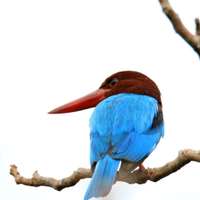
Between 06:30 and 09:00. Kingfishers, egrets and monitor lizards are active, the water is flat, and you avoid the 11:00–14:00 glare that flattens every photograph. The last useful departure is about 16:00, which gives good light but fewer birds.
Is Madu Ganga the same thing as Bentota River?
No. Bentota River (Bentota Ganga) is a separate estuary about 12 km north, and its safaris are shorter and busier. Madu Ganga is larger, has the mangrove tunnels and the temple island, and is the one with Ramsar protection.
Are there crocodiles in Madu River?
Yes — mugger crocodiles live in the estuary and the Ramsar listing names the species as one of the site's notable animals. Sightings are uncommon on a two-hour tourist run. Water monitors, which crews often point to as "crocodiles", are far more likely.
Can I combine the boat trip with the Kosgoda turtle hatchery?
Yes, and it is the most common pairing — Kosgoda is roughly ten minutes south of the jetties. Read our page on the hatcheries first: they vary a great deal in how they treat the animals, and the entrance fee is almost always separate from the boat price.
Is this the official Madu River website?
No. This is an independent guide. We do not own boats, sell tickets or represent any operator on the river. Booking links go to GetYourGuide, an authorised reseller, and we earn a commission when you book through them.
Keep reading
- Madu River Boat Safari Prices — What It Costs in 2026There is no fixed price on Madu Ganga. At the jetty you rent a boat and haggle; online you buy a seat at a published rate. Understanding which market you are standing in is worth more than any number.
- The Madu Ganga Mangrove Safari, ExplainedThe mangrove tunnel is the photograph everyone comes for, and it lasts about ten minutes. The other hundred are what separate a good boat trip from a bad one.
- Madu River Boat Operators — Who Runs WhatThere is no association, no register and no grading. What exists is a row of jetties, about eleven business names that keep appearing in map searches, and a great deal of overlap between them.
- Best Time to Visit Madu River — Hours, Season and DurationBoats run all day and the trip works all year. But the gap between a 06:45 departure and a 13:00 one is the difference between a wildlife trip and a hot boat ride.