
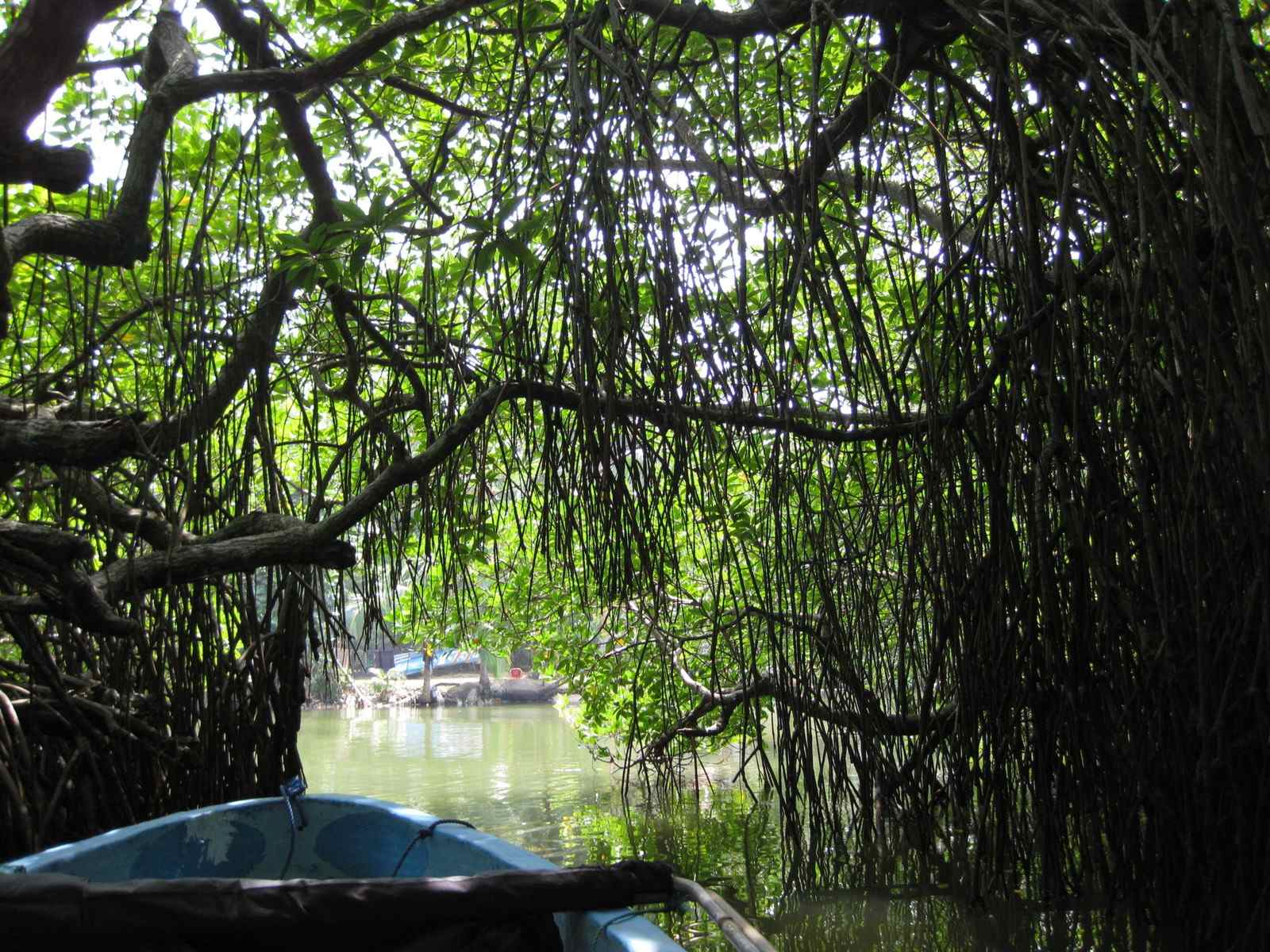
Madu Ganga is a lagoon rather than a river, which is why the mangroves matter so much here. Fresh water comes down from the hills, the ocean pushes salt water back up a four-kilometre channel twice a day, and the plants that can survive that daily swing dominate everything. What you are moving through on a boat is a forest that lives with its roots in brackish water.
What the route looks like
Boats leave the jetty and cross open lagoon first — five to ten minutes of nothing much, which is when crews get the engine noise out of the way. Then the channels narrow.
-
Open water
The wide part of the lagoon between the bridge and the island cluster. Flat, bright and empty. Look for cormorants drying their wings on stakes and for the wooden prawn traps set in the shallows.
-
The island channels
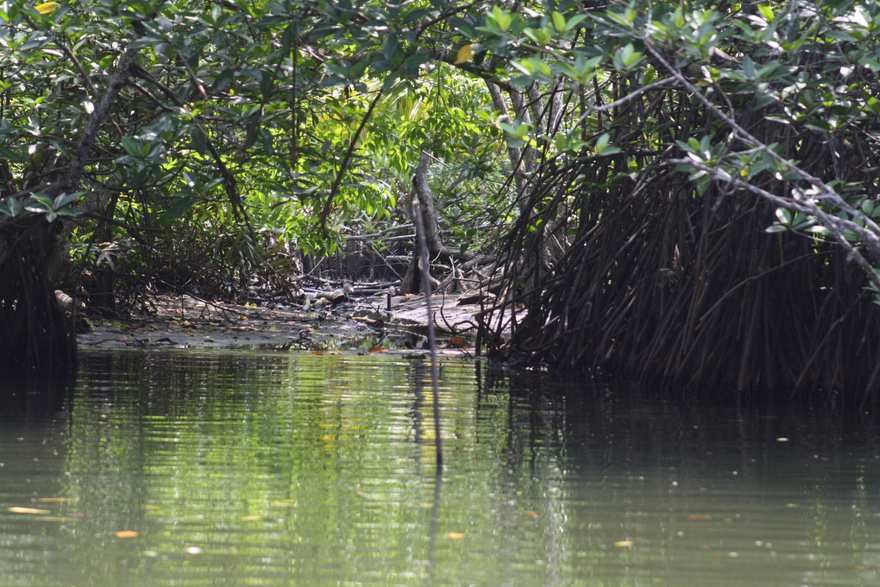
The boat threads between islands and the vegetation closes in. This is where you actually see the mangrove structure — stilt roots, breathing roots pushing up through mud, oysters clamped to the trunks at the tide line.
-
The mangrove tunnel
The narrowest section, where the canopy meets overhead. Engines drop to idle. Ten minutes at most, and worth every second of the rest of the trip.
-
The island stops
Kothduwa temple island, a cinnamon smallholding, the fish spa platform. Two of the three are worth your time; which two depends on you.
-
The run home
Back across the open lagoon, usually faster. Ask the driver to take the northern edge if there is time — the birdlife along the shallow margin is better than in the middle.
Why the tunnel is short and why that is fine
People arrive expecting an hour inside a green tunnel and are briefly disappointed. The tunnel is a real, natural channel between two islands; it is as long as it is. The value of the trip is not the ten minutes of canopy but everything the canopy is attached to — a functioning estuary with fish traps, kingfishers, monitor lizards, cinnamon smallholdings and a working temple, all inside 915 hectares.
What makes a mangrove tour good
The difference between crews is almost entirely about speed and engine discipline.
- A good crew cuts the engine. Near feeding herons, in the tunnel, at the temple jetty. You hear the estuary instead of the outboard.
- A good crew stays in the channel. Cutting corners over shallow root beds tears up new growth. You can see the damage along the busiest routes.
- A good crew explains the traps. Those wooden fences in the shallows are prawn and fish traps that have been set the same way for generations. Nobody points them out unless you ask.
- A good crew does not chase. Monitor lizards, kingfishers and monkeys all get chased by boats trying to produce a photo. It is unnecessary and it works badly — animals that are chased leave.
A mangrove safari is worth it if
- You want a genuine wetland rather than a staged attraction
- You are travelling with children who need something short and flat
- You care about birds, and you can leave before 08:00
- You want to understand how cinnamon is actually peeled
- You are on the coast between Bentota and Hikkaduwa anyway
Consider skipping it if
- You are hoping for big-game wildlife — this is not Yala
- You can only go between 11:00 and 15:00 in the dry season
- You dislike being taken to shops mid-activity
- You have already done Bentota River and want something different
- Heat and open sun are a real problem for you
The ecology, briefly and without romance
Mangroves hold the sediment that would otherwise wash into the sea, they shelter juvenile fish that the coastal fishery depends on, and they take the first hit from storm surge. That last function is why the Sri Lankan south-west coast takes them seriously: the belt of vegetation along an estuary is a physical buffer, and the 2004 tsunami made the point in a way no policy document could.
The Ramsar listing describes relatively undisturbed mangrove vegetation on the islands and shores, and names species of conservation concern including the endemic and endangered Shorea affinis and the vulnerable mugger crocodile. It also counts 15 islands, not the 64 that appear in tour marketing — the higher number counts every vegetated sandbar.
Getting the photograph
The tunnel is dark green under a bright sky, which is a difficult exposure on any camera.
- Go early. Between 06:30 and 08:30 the contrast is manageable; at midday it is not.
- Expose for the leaves and let the sky blow out. Trying to save the highlights turns the tunnel into a silhouette.
- Ask the driver to stop rather than drift. Ten seconds stationary is worth twenty frames taken from a moving boat.
- Turn around. The best composition is usually behind you, looking back down the channel you have just come through.
- Keep the camera in a dry bag between stops. Spray comes over the bow on the open crossing.
Where the mangrove safari fits in a day
Two hours on the water, plus travel. From Ahungalla or Kosgoda you are back before nine. From Bentota or Induruwa, before ten. From Galle or Hikkaduwa it eats the morning. From Colombo it is a full day and only makes sense bundled with Galle Fort or a turtle hatchery, which is exactly how it is sold.
Sources
- Ramsar Sites Information Service — Maduganga (site 1372) Area, island count, vegetation and species of concern
- The Convention on Wetlands — Sri Lanka names mangrove lagoon for the Ramsar List
- GetYourGuide — Madu Ganga boat safaris Durations and inclusions, checked 26 August 2026
Frequently asked questions
What is the mangrove tunnel on Madu River?
A narrow channel between two islands where mangrove branches meet overhead and close out the sky. Boats slow to walking pace and pass through in roughly ten minutes. It is a natural feature, not a built attraction, and it is the section most affected by tide height.
Can every boat go through the mangrove tunnel?
No. The larger covered boats used by some operators cannot fit. If the tunnel is the reason you are going, ask at the jetty whether the boat you are looking at can enter it, and take the smaller vessel even if it costs the same.
Does the tide affect the mangrove safari?
Yes, mainly in the tunnels. At high tide the clearance drops and everyone has to duck; at very low tide some side channels are too shallow. The main circuit runs at any state of tide, so this affects comfort rather than access.
How many mangrove species grow on Madu Ganga?
The wetland supports around 303 plant species across 95 families, of which the true mangroves are a small but dominant subset. Crews will point out the stilt-rooted Rhizophora, which is the classic tangled-root species people picture.
Is the mangrove forest actually protected?
Yes. Maduganga was added to the Ramsar list of Wetlands of International Importance on 11 December 2003 as site number 1372, covering 915 hectares. Protection on paper is stronger than enforcement on the water, which is why boat behaviour still varies.
Is the safari suitable for young children?
Generally yes. It is flat water, the boats are stable and the trip is short enough. Insist on a correctly sized life jacket before boarding rather than after, and take the earliest departure so you are not out in midday heat.
Keep reading
- What You Actually See on a Madu River TourEvery Madu Ganga boat makes the same three or four stops. Two of them are genuinely interesting, one is a novelty and one is a shop. Here is how to tell them apart before you pay.
- Madu River Wildlife — Birds, Monitors and What You Will Really SeeThe wetland supports 248 vertebrate species. A midday boat shows you four of them. What you see depends almost entirely on when you leave and how quietly your crew drives.
- The Ethics of a Madu River Boat TripA protected wetland with no gate, forty boats and no enforcement on the water. Most of the damage is casual rather than malicious, and most of it stops if a passenger asks.
- Madu River Boat Safari Prices — What It Costs in 2026There is no fixed price on Madu Ganga. At the jetty you rent a boat and haggle; online you buy a seat at a published rate. Understanding which market you are standing in is worth more than any number.